
Introduction
Electronic devices depend on a fairly wide range of magnetic components to steer, save, and pass electrical energy without too much loss. Among the key parts you will keep seeing are the inductor, and the flyback transformer. Both of them lean on magnetic fields and they can look similar at first glance, but they do different jobs in power conversion and the electronic circuit plan, so it matters a lot.
As companies move toward advanced electronics, and as renewable energy systems, electric vehicles, industrial automation, plus high-efficiency power supplies grow, it becomes more and more necessary to understand what inductors and flyback transformers actually do. Engineers, technicians, and also procurement professionals, often run into these pieces when building or servicing current electrical systems.
What Is an Inductor?
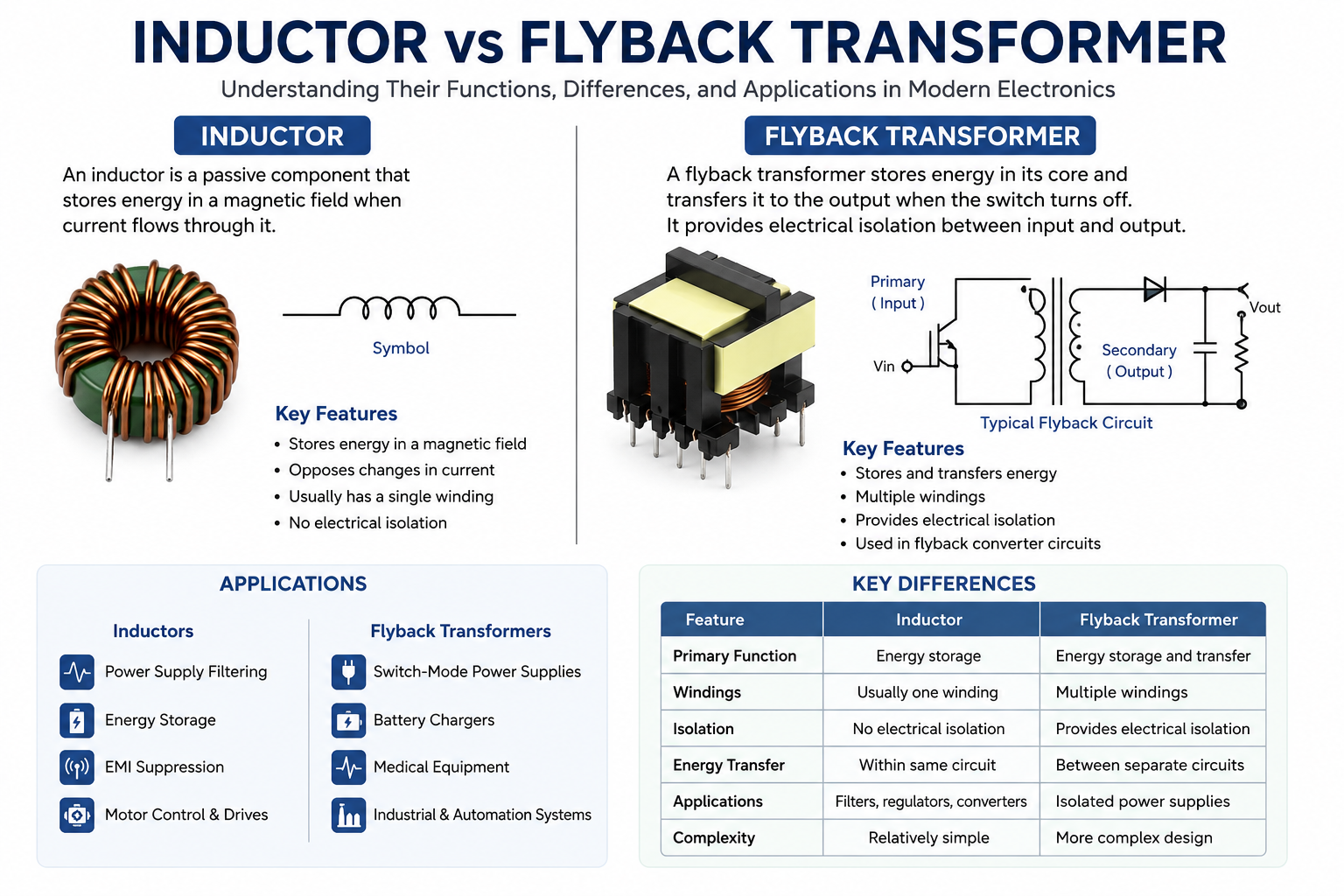
An inductor is a passive electronic component that basically keeps or saves energy in a magnetic field, when electric current runs through it. Usually it’s made with a conductive wire wound around a core material. Some inductors however go for air-core layouts, which is kinda simpler in a way.
The main job of an inductor is to push back against abrupt changes in current. So when the current rises or drops, the inductor makes a magnetic field that fights that change. In the end it helps keep things steadier in circuit operation, so the overall behavior doesn’t swing as much.
Basic Working Principle
When electrical current flows through the coil:
- A magnetic field develops around the conductor.
- Energy is stored within the magnetic field.
- Changes in current create an induced voltage that opposes the change.
This behavior makes inductors valuable in filtering, energy storage, and power regulation applications.
Common Types of Inductors
Air-Core Inductors
These inductors use air as the magnetic medium.
Advantages include:
- Low core losses
- High-frequency performance
- Minimal magnetic saturation
They are commonly found in radio frequency (RF) circuits and communication equipment.
Iron-Core Inductors
Iron-core inductors offer higher inductance values by concentrating magnetic flux.
Applications include:
- Power supplies
- Industrial equipment
- Energy storage systems
Ferrite-Core Inductors
Ferrite materials provide excellent performance at high frequencies.
Common uses include:
- Switching power supplies
- Telecommunications equipment
- Consumer electronics
Toroidal Inductors
Toroidal inductors use a ring-shaped core that improves magnetic efficiency while minimizing electromagnetic interference (EMI).
They are frequently used in:
- Audio equipment
- Medical devices
- Renewable energy systems
What Is a Flyback Transformer?
A flyback transformer is this particular magnetic component that is often used in flyback converter circuits. Even though the name sounds like it should behave like a classic transformer, it kinda doesn’t.
Instead of doing the straightforward energy transfer from the primary winding to the secondary winding in one go, a flyback transformer stores energy in its magnetic core during one part of the switching cycle, then later it releases that energy during a different part.
So, in a practical sense, it ends up acting a little like a coupled inductor, but it also keeps the electrical isolation intact.
How a Flyback Transformer Works
The operation of a flyback transformer occurs in two stages:
Energy Storage Phase
When the switching transistor turns on:
- Current flows through the primary winding.
- Magnetic energy accumulates in the core.
- The secondary winding remains inactive.
Energy Transfer Phase
When the switch turns off:
- The magnetic field collapses.
- Stored energy transfers to the secondary winding.
- Output voltage is delivered to the load.
This energy storage and release cycle allows flyback converters to achieve efficient voltage conversion while maintaining isolation between input and output circuits.
Key Differences Between an Inductor and Flyback Transformer
Although both devices use magnetic fields, their operating principles and applications differ significantly.
|
Feature |
Inductor |
Flyback Transformer |
|
Primary
Function |
Energy
storage |
Energy
storage and transfer |
|
Windings |
Usually
one winding |
Multiple
windings |
|
Isolation |
No
electrical isolation |
Provides
isolation |
|
Energy
Transfer |
Within
same circuit |
Between
separate circuits |
|
Applications |
Filters,
regulators, converters |
Isolated
power supplies |
|
Complexity |
Relatively
simple |
More
complex design |
Understanding these differences helps engineers select the most appropriate component for specific applications.
Applications of Inductors
Power Supply Filtering
Inductors remove unwanted electrical noise and smooth current flow in power systems.
Benefits include:
- Reduced ripple voltage
- Improved efficiency
- Enhanced equipment reliability
Energy Storage in DC-DC Converters
Many switching regulators rely on inductors to store and release energy during voltage conversion.
Applications include:
- Laptop chargers
- Electric vehicles
- Renewable energy systems
Electromagnetic Interference Suppression
Inductors help reduce electromagnetic interference that can disrupt nearby electronic equipment.
Motor Control Systems
Industrial motor drives use inductors to improve current regulation and system stability.
Applications of Flyback Transformers
Switch-Mode Power Supplies
Flyback transformers are widely used in compact power supplies found in:
- Consumer electronics
- Networking equipment
- Industrial controls
Battery Charging Systems
Many charging circuits utilize flyback converters due to their efficiency and electrical isolation capabilities.
Medical Equipment
Medical devices often require isolated power supplies to meet safety standards.
Flyback transformers help provide:
- Patient protection
- Electrical isolation
- Stable power delivery
Industrial Automation
Control systems and industrial electronics frequently employ flyback transformers to achieve reliable power conversion in demanding environments.
Design Considerations
Core Material Selection
Both inductors and flyback transformers depend heavily on core material properties.
Factors influencing material selection include:
- Operating frequency
- Temperature range
- Efficiency requirements
- Power levels
Common materials include ferrite, powdered iron, and laminated steel.
Thermal Management
Heat generation can affect component performance and lifespan.
Engineers often implement:
- Improved airflow
- Heat sinks
- Advanced thermal materials
to maintain safe operating temperatures.
Electromagnetic Compatibility
Proper magnetic component design minimizes electromagnetic interference and supports compliance with industry regulations.
This consideration is especially important in healthcare, telecommunications, and aerospace applications.
Advantages of Inductors
Key benefits include:
- Simple construction
- High reliability
- Efficient energy storage
- Effective filtering capabilities
- Long operational life
These characteristics make inductors indispensable in nearly every electronic system.
Advantages of Flyback Transformers
Flyback transformers offer several unique advantages:
- Electrical isolation
- Multiple output voltages
- Compact design
- Cost-effective implementation
- High efficiency in low-to-medium power applications
Their versatility contributes to widespread adoption across numerous industries.
Industry Trends and Future Developments
Higher Efficiency Requirements
As energy regulations become stricter, manufacturers continue developing more efficient magnetic components.
Advancements focus on:
- Reduced core losses
- Improved winding techniques
- Enhanced thermal performance
Growth of Renewable Energy
Solar power systems, energy storage installations, and electric vehicle infrastructure are increasing demand for both inductors and flyback transformers.
Miniaturization
Modern electronic devices require smaller and lighter components without sacrificing performance.
New materials and manufacturing processes are helping meet these requirements.
Smart Power Electronics
Digital control systems are creating opportunities for advanced magnetic component designs that improve monitoring, efficiency, and reliability.
Challenges Facing Designers
Despite technological improvements, several challenges remain:
- Managing thermal stress
- Reducing electromagnetic interference
- Achieving higher power density
- Controlling manufacturing costs
- Meeting increasingly stringent efficiency standards
Addressing these challenges will continue to drive innovation in magnetic component design.
Conclusion
The inductor and flyback transformer, are kind of basic building blocks in lots of modern electronic systems. Each one does its own job, but also they work together in a complementary way. The inductor mostly stores energy and helps with current regulation , while the flyback transformer gives both energy storage and isolated power transfer, so they’re useful in different stages of conversion. You can see them everywhere in power supplies, industrial automation, healthcare gear, renewable energy systems, and consumer electronics, which shows how important they are in the whole tech landscape.
As companies push for higher efficiency, smaller size , and more sustainability, improvements in magnetic materials and power conversion methods will keep expanding what both inductors and flyback transformers can do. If you understand what they actually do and where they fit, you can make better design decisions too, and that helps electronic systems become more reliable and efficient over time .