
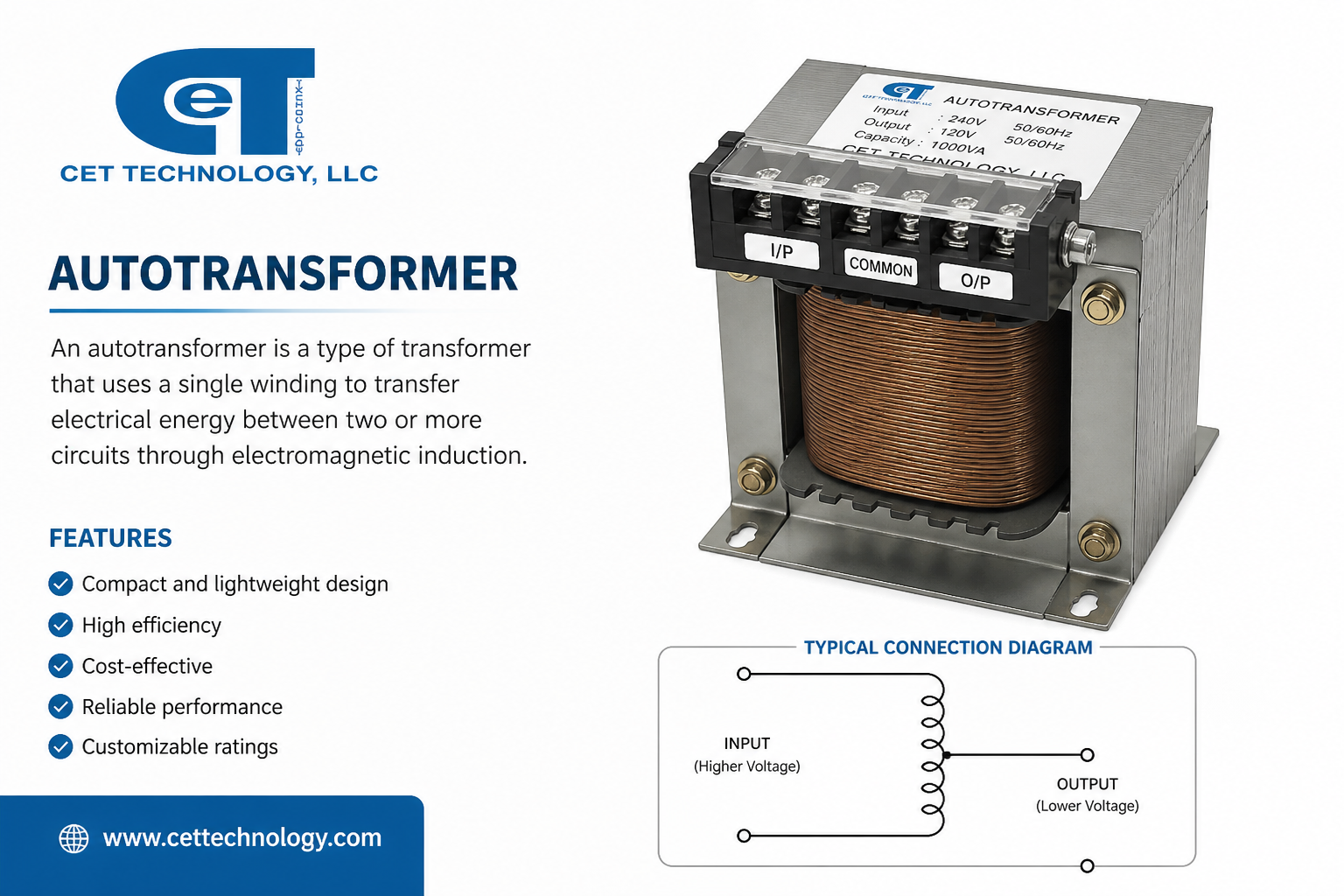
Walk into almost any industrial facility and you’ll find equipment running nonstop — motors, cooling systems, production machines, compressors, conveyors. Most people focus on the machines themselves. Very few pay attention to the power equipment keeping everything stable behind the scenes.That’s usually where the autotransformer comes in.It’s not the kind of component people brag about during meetings. Still, when voltage needs to be controlled efficiently without wasting space or money, an autotransformer is often the first thing experienced engineers look at.And honestly, there’s a reason older technicians still trust them. They’ve proven themselves for years.
Understanding How an Autotransformer Works
At first glance, an autotransformer looks similar to a standard transformer. The difference is inside the winding structure.Instead of using two separate windings, it uses one shared winding for both input and output voltage. Part of the coil does double duty.That simpler construction changes a lot of things.It reduces material usage, improves efficiency, and keeps the overall unit more compact. In real-world installations, that can save both cabinet space and operating cost.Not bad for something most people never notice sitting inside a control panel.
Why Industries Continue Using Autotransformers
A lot of newer electrical products show up with fancy marketing and oversized promises. Yet the autotransformer keeps holding its place in industrial systems because it solves practical problems without adding unnecessary complexity.
Improved Energy Efficiency
One thing engineers care about immediately is power loss.Because the winding is shared, less energy gets wasted during voltage transfer. That makes the autotransformer more efficient than many traditional transformer setups.For facilities running equipment all day, every day, that efficiency starts adding up financially pretty quickly.Electric bills have a way of getting everyone’s attention.
Easier Installation
Space disappears fast inside industrial electrical panels.Between breakers, drives, contactors, and other electrical components including Transformers, layouts can become crowded before a project is even finished.Autotransformers help because they’re usually smaller and lighter than conventional transformer systems handling the same load.That may sound minor until somebody has to fit everything into an already packed enclosure.
Lower Equipment Cost
Less copper and core material generally means lower manufacturing cost.That’s one reason companies like CET Technology continue supplying autotransformer solutions for commercial and industrial applications where electrical isolation is not required.Simple designs often end up being the most economical ones.
Where Autotransformers Are Commonly Used
People are often surprised by how many industries rely on these systems daily.
Motor Starting Applications
Large motors create huge startup currents. Sometimes the electrical demand spikes so hard it stresses the entire system.An autotransformer helps reduce that startup voltage temporarily, allowing motors to start more smoothly.I remember seeing an older production building where lights flickered every time a heavy conveyor motor started. The maintenance crew blamed the utility company for weeks. Turned out the facility simply needed a better motor starting solution.Problem solved.
Manufacturing Equipment
Production equipment depends on stable voltage to avoid interruptions and premature wear.Autotransformers are commonly used in assembly lines, industrial machinery, and automated systems where steady electrical performance matters.
HVAC Systems
Cooling and ventilation systems can become sensitive to voltage fluctuations, especially during seasonal heavy loads.Proper voltage control helps extend equipment life and improve reliability.And replacing industrial compressors is never cheap. Ever.
Autotransformer vs Conventional Transformer
This comparison comes up constantly in electrical projects.The biggest difference is electrical isolation.A traditional transformer separates the primary and secondary circuits completely. An autotransformer does not.That means conventional transformers are often preferred for:
- Medical environments
- Sensitive electronics
- Isolation-critical systems
- Certain safety applications
But in many commercial and industrial situations, isolation simply isn’t necessary. In those cases, an autotransformer usually provides a more efficient and cost-effective solution.Choosing the right option depends on the actual application, not internet hype.
Build Quality Matters More Than People Think
This part gets overlooked way too often.Two autotransformers may look nearly identical from the outside, yet perform completely differently over time.Poor insulation, weak winding construction, and inadequate cooling design can shorten equipment life fast. Excess heat is usually the first warning sign.Then come shutdowns.Then somebody starts making stressful phone calls at midnight.Reliable manufacturers pay attention to thermal stability, material quality, and voltage consistency under changing loads. That’s the kind of stuff that matters years later when the system is still running properly.
Things to Check Before Buying an Autotransformer
A little planning upfront saves major headaches later.
Voltage Requirements
Always confirm both input and output voltage ratings carefully. Guessing here usually ends badly.
Load Capacity
Never size a transformer exactly at maximum operating load. Leave room for startup demand and future expansion.
Operating Conditions
Heat, dust, moisture, and vibration all affect transformer lifespan. Industrial environments are tough on electrical components including Transformers.
Long-Term Reliability
Cheap equipment often becomes expensive equipment later through maintenance and replacement costs.Most experienced engineers learn that lesson once. Usually the hard way.
Final Thoughts
The autotransformer has stayed relevant for decades because it does exactly what industries need — reliable voltage control without unnecessary bulk or wasted energy.No complicated gimmicks.No oversized systems pretending to be revolutionary.Just practical performance that keeps equipment running efficiently day after day